
UNBOUND
BREAKING BARRIERS,
BUILDING FUTURES
Grow your career. Empowered by AI. Rooted in Wellbeing
We offer education and resources to help women and organizations
navigate emerging tech and build meaningful
success — without trading health, connection, or purpose.
UNBOUND
BREAKING BARRIERS,
BUILDING FUTURES
Grow your career. Empowered by AI.
Rooted in Wellbeing.
We offer education and resources to help women and organizations navigate emerging tech and build meaningful success — without trading health, connection, or purpose.
What We Offer
SElf-paced Courses and Resources

Assessments, Tools, Blog, Courses and Ebooks! See below
Live virtual
AI courses

Click Below to Sign up for our Next Course!
Custom trainings For your teams

Schedule a Meeting to Review your Specific Needs!
Whats Your #1 Career Growth Challenge?
Take Your FREE Assessment Here to see whats holding you back and what you can do about it!
Features and Benefits
NAVIGATE THE AI LANDSCAPE
Navigate digital transformation and AI to advance rather than hinder your career
FIND YOUR VOICE
Discover your authentic leadership voice and build unshakable confidence
BUILD YOUR BRAND
Develop a compelling personal brand that opens doors to new opportunities
NEGOTIATE LIKE A PRO
Master the art of strategic self-advocacy without compromising your values
BOUNDARY MANAGEMENT
Create boundaries that protect your energy while enhancing your impact
VALUE ALIGNED SUCCESS
Define success on your own terms, creating a path aligned with your deepest values
build your network
How to develop the relationships that amplify your voice, expand your opportunities, and accelerate your impact.
leadership presence
How to embody your authentic authority in ways that create meaningful impact while remaining true to your core values and identity.
work life balance
Learn to manage your energy, aligned with your values and purpose to build a life in balance
Upcoming Courses
The AI Leverage Foundation
August 2025
Are you ready to unlock your AI skills?
Join a guided experience where you’ll learn to build your own AI toolkit, simplify your workflow, and make AI a supportive part of your life or business.
Just smart strategy, aligned tools, and personal guidance to help you feel capable—not behind.



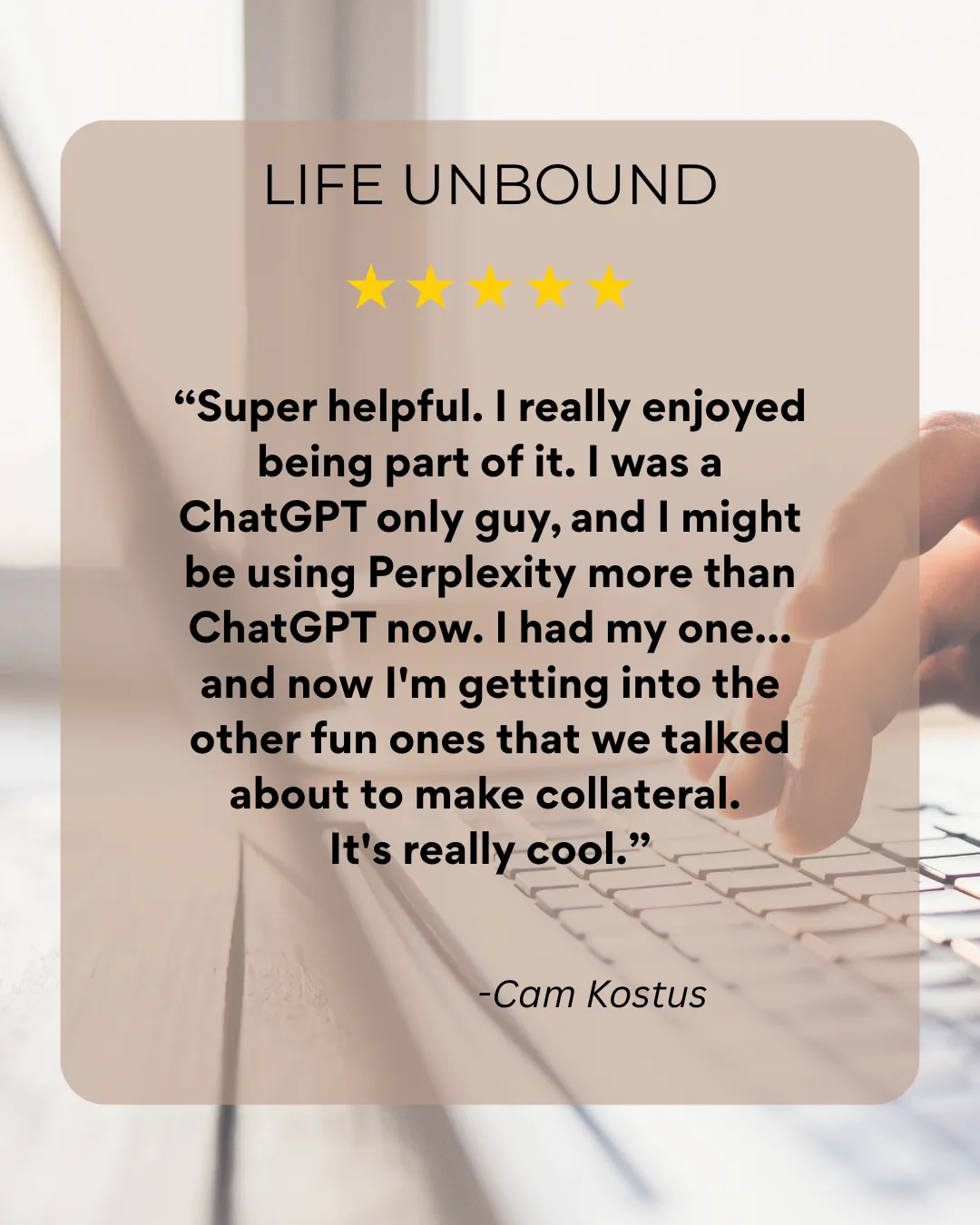
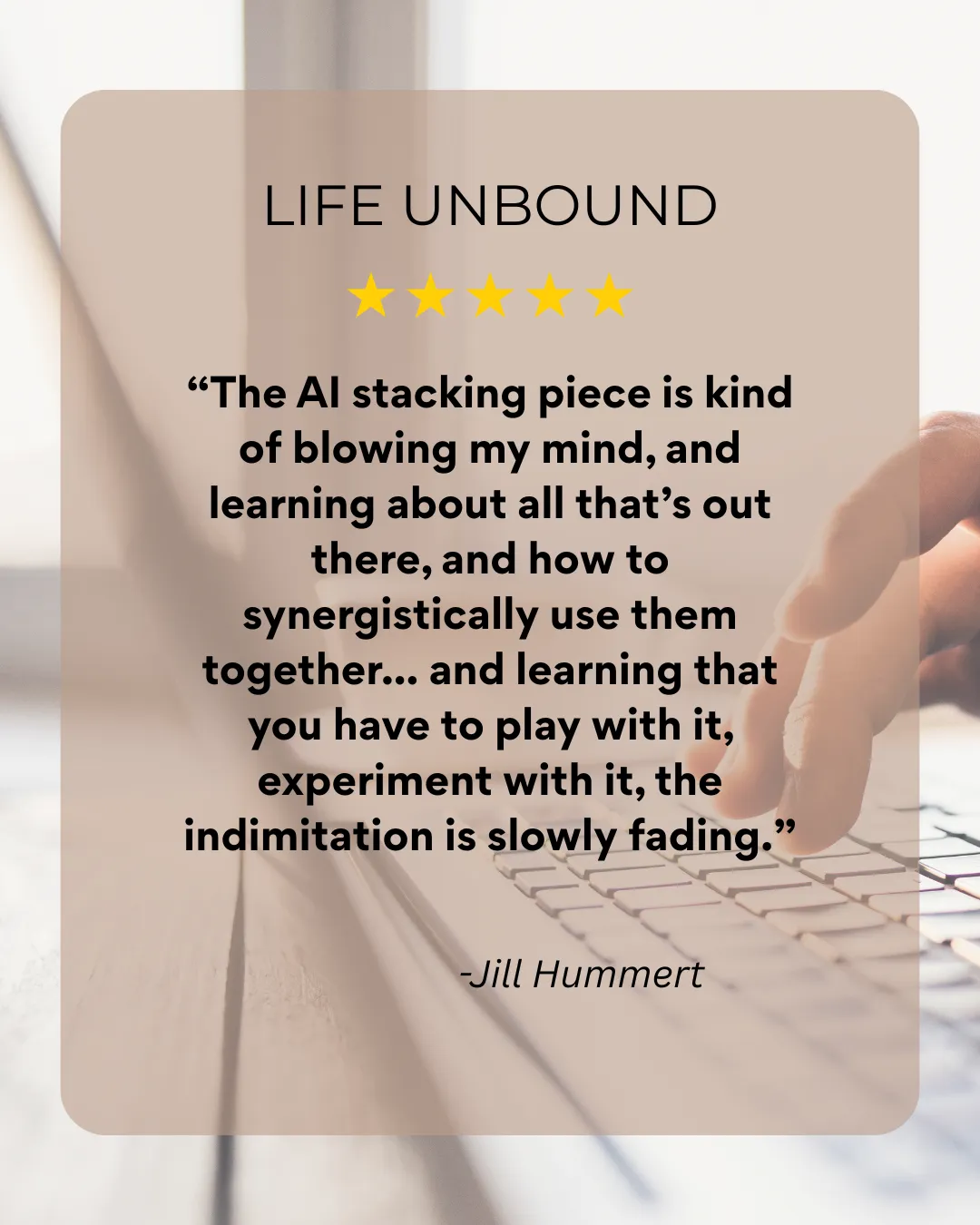
Ebooks COMING SOON
2025!!

Find Your Authentic Path to Success
In a world where women continue to navigate unique challenges in the workplace, "Unbound" byy Amie Rafter, offers a transformative roadmap for professional advancement on your own terms
This isn't just another career guide—it's a comprehensive companion that blends cutting-edge research with practical wisdom to address the specific obstacles women face, from imposter syndrome to visibility gaps, negotiation challenges to work-life boundaries.
Whether you're launching your career, pushing through the middle management barrier, or aiming for the C-suite, this book provides the tools to transform challenges and live your purpose and potential,
MEET THE FOUNDER & CEO
Amie Rafter
Founder Amie Rafter is a seasoned professional with a diverse background in business, leadership and personal development. She holds an MBA and BS in International Business, spent 24 years in the tech and medical device corporate world and 5 years in non-profit, prior to starting her own business supporting entreprenuers with practical launch strategies. Her combined experience in strategic sales, leadership, along with being a life, career coach, yoga teacher and most importantly, mother, has given her a unique set of tools and capacity to offer holistic support to women.
Amie developed the Unbound model and platform after both experiencing and seeing the challenges women face every day both as entrepreneurs and leaders. She understands that the unique energy and intentions women bring are designed to support the world in the ways we need now and she wants to scale that energy, removing traditional obstacles for her clients and companies.

Blog

AI Training Is Broken: What Responsible AI Training Looks Like
AI training is everywhere right now. Workshops, bootcamps, certifications, and prompt courses all offer promises of productivity gains and competitive advantage.
And yet, many organizations walk away disappointed.
The tools can bel confusing. Adoption stalls. Teams revert back to old habits. Leaders are left wondering whether AI is overhyped. Or they wonder if they chose the wrong training.
The uncomfortable truth is this: most AI training fails, not because people are incapable, but because the training itself is flawed. AI training is often designed to impress, not to change behavior.
If you’re considering hiring an AI consultant or trainer—here are the most common reasons AI training fails, and what responsible, effective training looks like.
1. AI Training Fails Because It’s Tool-First, Not Outcome-First
What goes wrong
Many AI trainings start with tools: “Here’s what this tool can do,” “Here are 50 prompts,” “Here’s the latest platform update.” Sure, employees leave with a lot of features—but they lack clarity on why or when to use them.
The result is predictable. Without a clear connection to outcomes, AI becomes something interesting to explore instead of a collaborative partner. Teams may experiment briefly, but they eventually move on.
What to look for instead
Responsible AI training starts with the outcomes, not the tools.
Before training your people, skilled AI trainers will ask key questions like:
What decisions or workflows are you trying to improve?
Where do time, quality, and risk matter most?
What does “better” look like in practice?
Tools are introduced only as a means to those ends. If training can’t clearly articulate how AI supports real work (faster turnaround, increased revenue, better analysis, fewer errors) it will most likely not stick.
2. AI Training Fails Because It Ignores Context
What goes wrong
Generic examples dominate most AI training. Marketing prompts shown to finance teams. Legal risks glossed over for regulated industries. Use cases that sound impressive, but don’t map to anyone’s job description. It's theoretical.
Employees see the mismatch. They may nod along, but mentally check out. The unspoken conclusion is: “This isn’t how we work.".
What to look for instead
Effective AI training must be contextual.
That doesn’t mean every session must be custom-built from scratch—but it does mean:
Use of examples relevant to the industry
Inclusion of specific scenarios that are aligned with specific roles
Acknowledgment of constraints (data sensitivity, compliance, brand risk)
When people see AI applied to their real life work context, adoption becomes possible.
3. AI Training Fails Because It’s Treated as a One-Time Event
What goes wrong
Employees sit through one or two slide-based presentations, after which they return to their desks—and nothing changes.
This isn’t unique to AI, but AI magnifies the problem. Without practice, skills decay quickly, all while technology continues to evolve rapidly. This kind of training may create awareness, but it doesn't improve capability.
What to look for instead
Responsible training treats AI as a learning process, not a session.
Strong programs include:
Clear learning paths, not just sessions
Time and space for hands-on exploration and application
Follow-up, reinforcement, and iteration
The goal isn’t to “cover AI” but to help people build confidence using it responsibly over time.
4. AI Training Fails Because Responsibility Is an Afterthought
What goes wrong
Ethics, bias, data privacy, and misuse are often rushed through on the final slide—if they appear at all. Sometimes responsibility is framed as a legal checkbox rather than a real ethical concern.
This creates two risks:
Overconfidence (“We didn’t hear about risks, so there must not be many.”)
Paralysis (“This seems dangerous; let's not touch it.”)
Neither leads to healthy adoption.
What to look for instead
Responsible AI training treats guardrails as core content, not as disclaimers.
That means:
Clear boundaries on what's appropriate
Real life examples of what not to do
Guidance on decision-making, not just rules
Good training doesn’t frighten employees—but it doesn’t pretend risks don’t exist. Skilled AI trainers empower teams to navigate the risks thoughtfully.
5. AI Training Fails Because No One Defines Success
What goes wrong
After training, leaders ask, “Did this work? Do our people get it?” but no one can answer. There were no benchmarks, no expectations, and no agreed upon definition of success.
Without this, training is judged on how people feel instead of the value it provides to the company..
What to look for instead
Effective AI training defines success upfront.
Not vanity metrics, but meaningful measurements:
Are workflows changing?
Are decisions faster or more informed?
Are people collaborating with AI confidently and appropriately?
When success is defined, training becomes accountable—and improvable.
What Responsible AI Training Actually Looks Like
Responsible and effective AI training has a few consistent characteristics:
Outcome-driven, not tool-focused
Grounded in real context
Designed for learning over time
Explicit about responsibility and risk
Clear on the definition of success.
It doesn’t promise transformation overnight. It builds capability with time and practice.
If you’re evaluating AI consultants or trainers, these principles matter far more than certifications, buzzwords, or flashy trainings.
Ready for the next step?
If you want a practical starting point—without hype or fear—
👉 Check out Hbird’s offerings https://hbirdco.com/courses
FAQ 1: Why does most AI training fail?
Most AI training fails because it focuses on tools instead of outcomes, ignores real business context, lacks follow-through, and doesn’t define what success looks like. Without responsibility and reinforcement, adoption stalls.
FAQ 2: What is responsible AI training?
Responsible AI training helps teams use AI with clear intent, practical guardrails, and human accountability. It emphasizes judgment, context, and long-term capability—not just prompts or tools.
FAQ 3: How can I tell if AI training is high quality?
High-quality AI training is outcome-driven, contextualized to your work, explicit about risks and boundaries, and designed as an ongoing learning process rather than a one-time workshop.
FAQ 4: Is AI training better than hiring AI consultants?
AI training and AI consulting serve different purposes. Training builds internal capability, while consultants often focus on implementation or strategy. The best approach depends on your goals, maturity, and resources.
FAQ 5: What should organizations avoid when adopting AI?
Organizations should avoid using AI without clear boundaries, delegating decisions to AI without human oversight, and treating AI adoption as a one-off initiative rather than a learning process.
Key Collaborators


Unbound is a sub brand of Hbird Consulting LLC
Looking to start a business or accelerate an existing one? Hbird Consulting offers Vision to Launch coaching and business development support. Check us out at hbirdco.com
Trusted By
Amie's support is personally and professionally empowering. Her services helped me overcome challenges and limiting blocks, moving forward with confidence and clarity in my work and life."

Samantha Berwick
Founder at Embodied Arts Healing
Business Consulting
The Unbound program gave me the frame work I needed to rapidly evolove and transform into the leader and change-maker I came here to be. The program helped me find a balance beteen structure and flow and allowed me the courage
to lean on my network more than ever.

Tracy Tarlow
Founder at Springboard Connectivity
Non-Profit